
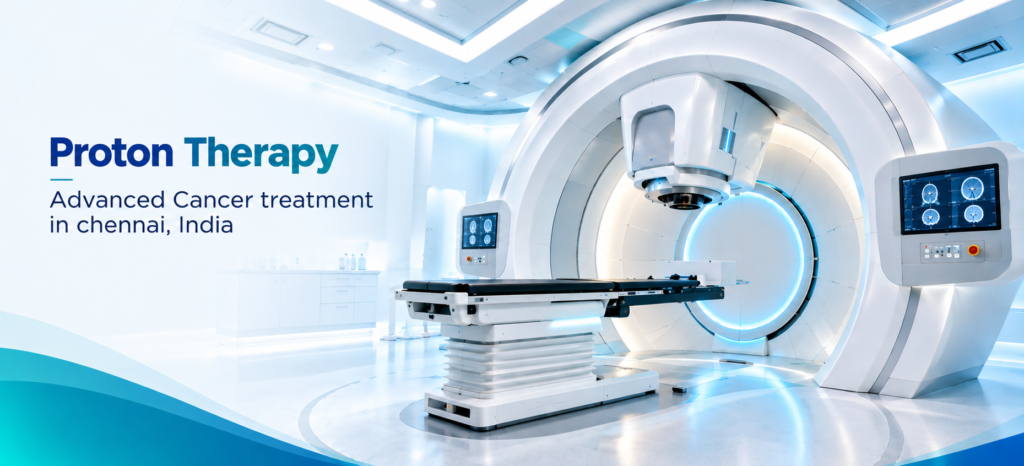
What is Proton Therapy?
Proton Therapy is one of the greatest advancements in medical science. It is a highly accurate and advanced form of radiation therapy used to treat different types of cancer.This is not a traditional method like X-ray radiation, which is known as photon therapy.In photon therapy, radiation is released all the way through the body, which can affect healthy tissues.In contrast, Proton Therapy uses positively charged particles called protons.These protons are released only when they reach the exact location or depth in the body where the tumor is located.This allows the maximum energy to be delivered directly to the cancerous tissue, while minimizing damage to the surrounding healthy tissues.
This therapy is especially beneficial for treating cancers located near important structures and sensitive organs such as the brain, spine, lungs, and eyes.
Proton Therapy is also recommended for children, as their bodies are still growing and developing, ensuring that the treatment is as safe as possible.
Proton Therapy in India is available only at Apollo Hospital in Chennai.
The procedure is non-invasive and painless, unlike traditional methods.Each session typically lasts about 15 to 30 minutes, and patients experience very few side effects.However, the effects can vary depending on the individual and the severity of the condition.

Apollo Hospital, Chennai is the only hospital in India, and even in South Asia, that offers Proton Therapy.
Patients from all over the country and around the world come to this hospital for this unique and specialized treatment.
Know More About Proton Therapy
Proton Therapy was first introduced in 1946 by American physicist Robert R.Wilson.In the 1950s and 1960s, it was primarily used in physics research centers. However, it was limited to clinical trials until the 1990s, when hospital-based proton therapy centers were established in the United States and Europe.Now, with significant advancements in imaging and beam control technology, Proton Therapy has become the safest and most painless form of radiation therapy available. Apollo Hospital, Chennai in India has played a key role in bringing this revolutionary treatment to South Asia.
What Is Proton Therapy Used For?
Proton Therapy in India is an advanced form of radiation therapy used when a cancer requires precise targeting to avoid harming nearby healthy tissues and critical organs.
It is mainly used for tumors located in the following areas:
– Near vital structures, such as the optic nerves, spinal cord, and brain
– In pediatric patients to prevent long-term complications related to growth and development
– In areas that have been previously treated with radiation
– In cases where a second radiation treatment is required (re-irradiation)
Proton Therapy is advised when the risk of complications from conventional X-ray radiation is too high, especially when higher doses are needed to effectively destroy the tumor.
Procedure of Proton Therapy in India
In India, Proton Therapy procedures use the unique physical properties of protons.
Unlike traditional radiation therapy, which releases energy at a specific point called the Bragg Peak, Proton Therapy delivers the radiation precisely to the tumor.This ensures that the tumor is targeted with extreme accuracy, while minimizing exposure to healthy tissues and vital organs.The high doses of radiation can be harmful to healthy cells, but expert oncologists in India ensure that the treatment is delivered with exceptional precision.
Types of Cancer Treated with Proton Therapy
Proton Therapy is used to treat various types of cancers, especially those that require extreme precision because of their proximity to critical organs or in patients who are more sensitive to radiation toxicity.
Paediatric Cancer
- Medulloblastoma
- Ependymoma
- Rhabdomyosarcoma
- Retinoblastoma
- Neuroblastoma
- Wilms’ tumor
- Ewing sarcoma
- Osteosarcoma (in selected cases)
Brain and Central Nervous System Tumors
- Gliomas (low- and high-grade)
- Meningiomas
- Acoustic neuromas (vestibular schwannomas)
- Craniopharyngiomas
- Pineal gland tumors
- Chordomas and chondrosarcomas at the skull base
Head and Neck Cancer
- Nasopharyngeal carcinoma
- Paranasal sinus cancers
- Oropharyngeal cancer
- Laryngeal and hypopharyngeal cancers
- Salivary gland tumors
- Skull base tumors
- Recurrent head and neck cancers
Eye and Orbital Tumors
- Intraocular melanoma (uveal melanoma)
- Retinoblastoma
- Orbital sarcomas
Prostate cancers
- Localized prostate cancer
- High-risk and recurrent prostate cancer
- Patients who have had previous radiation or surgical treatment
Breast cancers
- Early-stage breast cancer
- Patients who have undergone mastectomy with chest wall involvement
- Patients needing irradiation of lymph nodes
- Patients with a history of heart issues or medical implants
Lung and Thoracic Cancers
- Non-small cell lung cancer (NSCLC)
- Small cell lung cancer (in certain cases)
- Thymoma
- Mediastinal tumors
- Chest wall sarcomas
- Mesothelioma (in selected cases)
Gastrointestinal cancers
- Esophageal cancer
- Pancreatic cancer
- Liver cancer (hepatocellular carcinoma, cholangiocarcinoma)
- Gastric (stomach) cancer
- Anal and rectal cancers (in selected cases)
- Retroperitoneal sarcomas
Gynaecologic cancers
- Cervical cancer (re-irradiation or locally advanced)
- Endometrial cancer (in complex pelvic anatomy)
- Vaginal and vulvar cancers
Genitourinary Cancers
- Bladder cancer (in selected patients)
- Kidney cancer (post-surgical bed irradiation)
- Testicular cancer (in rare cases with retroperitoneal spread)
Sarcomas
- Osteosarcoma
- Ewing sarcoma
- Chondrosarcoma
- Rhabdomyosarcoma
- Leiomyosarcoma
Hematologic Cancers
- Recurrent lymphoma affecting the central nervous system or mediastinum
- Leukemia with central nervous system involvement (pediatric cases)
Recurrent or Previously Irradiated Cancers
- Head and neck cancers
- Brain tumors
- Pelvic tumors
- Spine tumors
Proton Therapy Cost in India
The cost of Proton Therapy in India varies adepends upon cancer type, tumor location, treatment complexity, number of sessions, diagnostic requirements, treatment planning and hospital.
There is no single cost that applies to every patient. A personalized estimate should be obtained after the oncology team reviews and diagnosed the patient’s medical condition and treatment requirements.
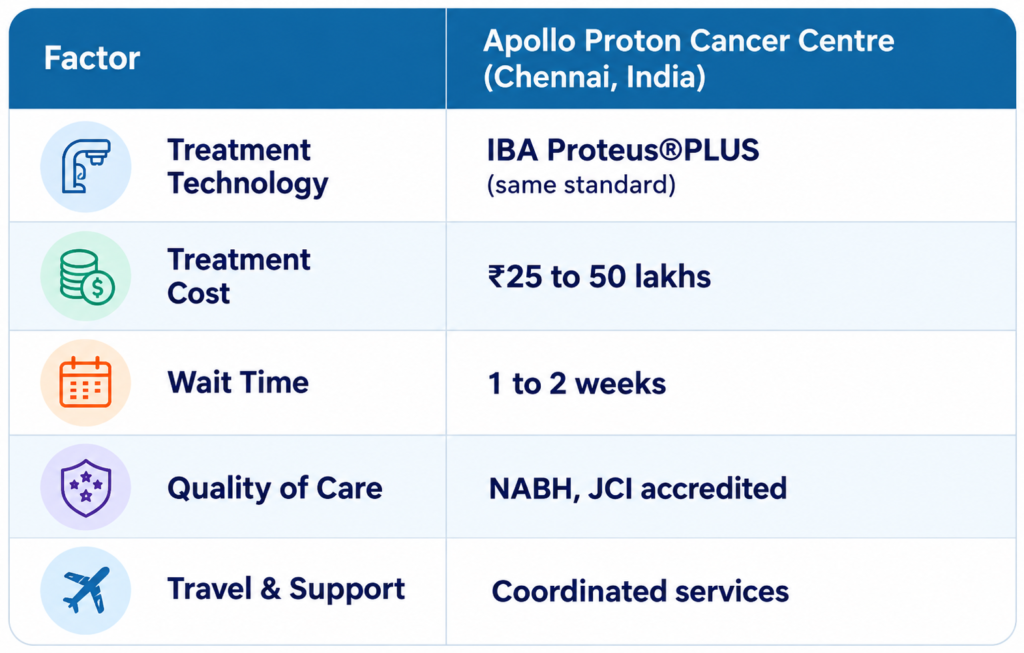
Proton Therapy Treatment Process in India
The treatment journey generally includes:
Medical Evaluation → Imaging & Simulation → Treatment Planning → Proton Therapy Sessions → Follow-up
The exact number of sessions varies from patient to patient. At APCC, for example, Apollo describes daily outpatient treatment schedules for many patients, with the overall course depending on the individual treatment plan.
For international patients, Healtripz can assist with medical report sharing, consultation coordination, hospital communication and other practical aspects of planning treatment in India.
FAQ ?
What is Proton Therapy for cancer treatment?
Proton Therapy is an advanced form of radiation therapy that uses high-energy protons to target cancer cells. Its physical properties allow radiation oncologists to plan the dose at a specific depth, which may help reduce radiation exposure to nearby healthy tissues in selected cases.
Is Proton Therapy available in India?
Yes. Proton Therapy is available at specialized cancer centres in India. Apollo Proton Cancer Centre in Chennai is one of the country’s dedicated Proton Therapy facilities.
Which cancers can be treated with Proton Therapy in India?
Proton Therapy may be considered for selected brain, spine, head and neck, eye, pediatric, prostate, lung, bone and soft-tissue and other cancers. Eligibility depends on the individual patient’s diagnosis and treatment plan.
Is Proton Therapy better than conventional radiation therapy?
Not necessarily for every patient. Proton Therapy may provide a dosimetric advantage in selected cases by reducing radiation exposure to surrounding healthy tissues. Modern photon radiation can also be highly precise, so the choice should be made based on the patient’s specific condition.
How much does Proton Therapy cost in India?
The Proton Therapy cost in India varies according to the cancer type, treatment plan, number of sessions, investigations and hospital. Patients should obtain a personalized estimate after medical evaluation.
How many Proton Therapy sessions are required?
The number of sessions is different for each patient. It depends on the type and location of cancer, prescribed radiation dose, treatment objective and the oncologist’s treatment plan.
Is Proton Beam Therapy painful?
Proton Therapy is a non-invasive radiation treatment. The radiation delivery itself is not typically painful, although patients may experience side effects depending on the treatment area and dose.
How can international patients get Proton Therapy in India?
International patients can share their medical reports with Healtripz for assistance with consultation and hospital coordination. The treating oncology team reviews the case and determines whether Proton Therapy is appropriate for the patient.