Hearing the words “brain tumour” is hard enough. Hearing that you may need surgery on the brain is harder still. For many patients, the biggest fear is not only the tumour itself, but what treatment might do to speech, memory, balance or vision.
This is exactly why radiosurgery has changed so much in the last two decades, and why ZAP-X gyroscopic radiosurgery in India is getting attention from patients across Africa, the Middle East, South Asia and beyond. In this guide we explain what ZAP-X is, how it works, who it may help, and what to expect if you are travelling to India for treatment.
What Is ZAP-X Gyroscopic Radiosurgery?
Despite the word “surgery”, ZAP-X does not involve a knife, a cut or an operating theatre. It is a form of stereotactic radiosurgery (SRS): a very precise, high-dose beam of radiation is aimed at a tumour or a small target in the brain while the tissue around it receives much less.
What makes ZAP-X different is the machine itself. It was designed from the start to treat the brain and the head and neck, and it was developed by ZAP Surgical Systems, a company founded by Dr. John R. Adler, a Stanford neurosurgeon who is also known as the inventor of the CyberKnife.
The name comes from its gyroscopic design. Instead of a fixed machine, the radiation source moves on two axes, a little like a gyroscope, so that beams can reach the tumour from many different angles. The beams cross at the target, where the dose adds up, while each individual beam passes through healthy tissue only briefly.
How Does ZAP-X Radiosurgery Work?
The treatment follows a simple logic, even if the technology behind it is advanced.
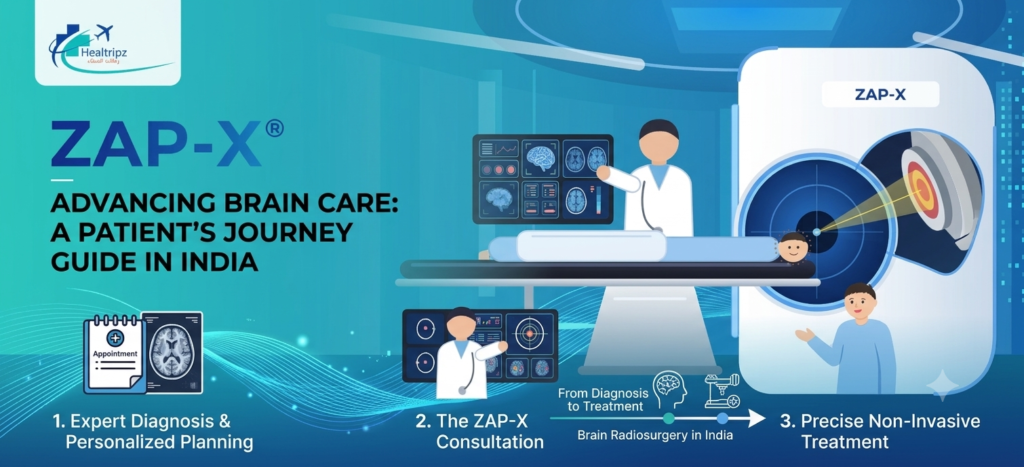
- Imaging and planning. Your doctors review MRI and CT scans and map the exact size, shape and position of the tumour.
- A tailored plan. A team of neurosurgeons, radiation oncologists and medical physicists designs a plan that delivers the prescribed dose to the target while keeping nearby structures, such as the optic nerves or brainstem, as safe as possible.
- Treatment. You lie comfortably on the couch while the system delivers the beams. There is no incision, and the treatment is generally painless.
- Going home. Radiosurgery is usually completed in one to five short outpatient sessions, and many patients return to normal activities on the same day or soon after. Your doctor will advise you on the right timing for your case.
Frameless and cobalt-free
Older radiosurgery systems often relied on a rigid head frame fixed to the skull, and many used a radioactive cobalt-60 source. ZAP-X works differently. It is designed for frameless treatment and uses a modern linear accelerator instead of cobalt. It also has a self-shielded, vault-free design, which means the hospital does not need a heavily shielded treatment room to install it.
For patients, the practical benefit is comfort and a more modern approach to the same goal: accurate treatment with as little impact on healthy brain tissue as possible.
Which Conditions Can ZAP-X Treat?
ZAP-X is designed for tumours and conditions of the brain and the head and neck. Depending on the case, your doctors may consider it for:
- Brain metastases (cancer that has spread to the brain from the lung, breast, kidney or elsewhere)
- Meningiomas
- Vestibular schwannomas (acoustic neuromas)
- Pituitary tumours
- Tumours in the pineal region and other deep areas that are difficult to reach with open surgery
- Arteriovenous malformations (AVMs)
- Trigeminal neuralgia, a severe facial pain condition
Not every patient is suitable for radiosurgery. Size, location, the type of tumour and your overall health all matter. The final decision always rests with your treating neurosurgeon and radiation oncologist after reviewing your scans.
Benefits Patients Look For
People usually ask us the same practical questions. Here is what ZAP-X is designed to offer:
- Non-invasive treatment. No incision, no general anaesthesia for most patients, and no hospital stay for the radiation itself in many cases.
- High precision. Beams from many angles help concentrate the dose on the tumour and protect surrounding tissue.
- Short treatment time. One to five sessions is common, which makes planning a trip to India more manageable.
- Quick return to routine. Many patients resume daily activities soon after treatment.
- Option for hard-to-reach tumours. Deep-seated tumours that are risky to operate on may be treated without opening the skull.
ZAP-X Gyroscopic Radiosurgery at Apollo Hospital, New Delhi
If you search for the best ZAP-X gyroscopic radiosurgery at Apollo Hospital, you will find that Apollo was an early adopter of this technology in the region. Apollo Hospitals announced a partnership with ZAP Surgical in 2022 to bring ZAP-X to India, with systems planned for New Delhi and Mumbai and a new Apollo Brain Center envisioned as a centre of excellence.
In March 2024, Apollo Hospital in New Delhi completed its first patient treatment on the ZAP-X platform, which was reported as the first ZAP-X treatment in South Asia. The first patient was a 66-year-old man with a metastatic tumour in the pineal gland, a small area deep in the centre of the brain that is difficult to reach with open surgery. Apollo’s New Delhi site was also named a regional reference site for ZAP-X training and visits.
In simple words: if you are looking for ZAP-X radiosurgery in India, Apollo Hospital in New Delhi is one of the established centres where you can ask for an evaluation. Healtripz can help you share your reports with the hospital and arrange a consultation.
ZAP-X vs. Other Radiosurgery Options
Patients often ask how ZAP-X compares with other systems such as Gamma Knife or CyberKnife. The honest answer is that the best option depends on your tumour and your doctor’s assessment.
- Gamma Knife has a long track record in brain radiosurgery and has traditionally used cobalt-60 sources.
- CyberKnife is a robotic system that can treat tumours in the brain and in other parts of the body, such as the lung, prostate and spine.
- ZAP-X is built specifically for the brain and head and neck, is frameless and cobalt-free, and does not need a shielded vault.
More choice is good news for patients. Ask your doctor why a particular system is recommended for you, and what outcomes they expect.

Why International Patients Choose India for Radiosurgery
People travel to India for advanced cancer and neurological care for a few common reasons: access to modern technology, experienced specialists, English-speaking medical teams and treatment costs that are often lower than in the US, UK or Europe. Short-course treatments like radiosurgery are especially practical for travellers, because you may not need a long stay.
The journey still needs planning. Medical visa, reports, appointments, accommodation, airport pickup and translation can feel like a lot when you are already worried about your health. This is where a coordinator makes the difference.
How Healtripz Helps You Get ZAP-X Treatment in India
Healtripz is a medical travel facilitator for international patients. We are not a hospital, and we do not make medical decisions. What we do is make the process clearer and less stressful:
- Review your MRI, CT and medical reports and share them with the right specialists
- Obtain a medical opinion and a written cost estimate before you travel
- Help with the hospital invitation letter for your medical visa
- Arrange airport pickup, accommodation and local support
- Stay in touch with you and your family through treatment and follow-up
Frequently Asked Questions
What is ZAP-X gyroscopic radiosurgery?
ZAP-X is a non-invasive radiosurgery system that delivers precise beams of radiation to tumours of the brain and the head and neck. Its gyroscopic design lets the radiation source move to many angles around the patient, which helps concentrate the dose on the target while sparing nearby tissue.
Is ZAP-X radiosurgery available in India?
Yes. ZAP-X radiosurgery is available in India, and Apollo Hospital in New Delhi treated its first patient on the platform in March 2024. Availability can change, so confirm the current status with the hospital or with Healtripz before you plan your trip.
Is ZAP-X treatment painful?
The treatment itself is generally painless. You lie on a couch while the system delivers the radiation, and there is no incision. Your care team will explain what to expect for your case.
How many sessions does ZAP-X treatment need?
Radiosurgery is commonly delivered in one to five sessions, depending on the size and location of the tumour. Your doctors will decide the schedule after reviewing your scans.
How much does ZAP-X radiosurgery cost in India?
The cost depends on the condition, the treatment plan, the hospital and any additional tests or stay. Instead of guessing, share your reports with Healtripz and we will help you get a written estimate from the hospital.
Can I get a second opinion before travelling?
Yes. You can send your scans and reports for a remote review. This helps you understand your options before you commit to a trip.